

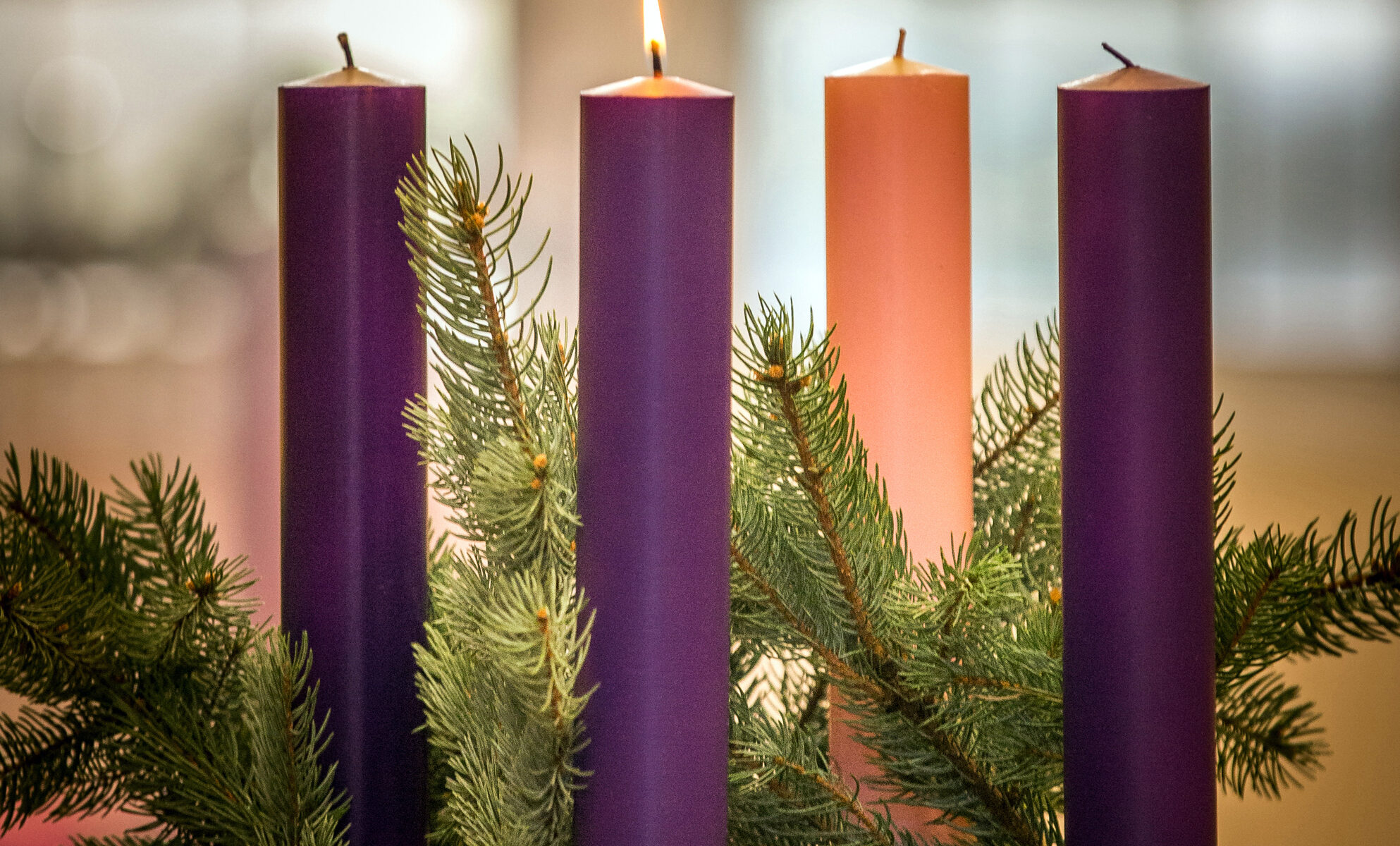
A Sermon for the First Sunday of Advent, by Abbot Kenneth Gillespie
May the grace of our Lord Jesus Christ, and the love of God, and the fellowship of the Holy Spirit be with you all.
Today is the beginning of my favorite season of the Church year, Advent. In our Collect this morning, we prayed for grace “to cast away the works of darkness, and put on the armor of light.” These two movements, casting off and putting on, frame not only this day’s worship but the entire Advent season. This is our work for the next four weeks: to remove what hinders us and to clothe ourselves in Christ’s light as we prepare for His coming.
We were reminded, in our Gospel lesson, that our Lord is indeed returning and were encouraged to keep watch and be ready. That is what this Advent season is really all about, purposefully waiting for Christ. In the next few verses following our reading from the Holy Gospel this morning, our Lord tells us that if a master of a house knows in what part of the night a thief is coming, then he would of course stay away and deter the break-in. Is that not something we could all relate to, the desire to protect and preserve our property, our belongings, our money. Would we not also be willing to do as he says, to stay awake, to stand watch in order to preserve what is ours. How much more so then, should we be willing to stand watch to preserve our souls, to be found ready at the return of Christ.
Saint Paul tells the Romans that the night is far gone, the day is at hand. It is time to cast off the works of darkness and put on the armor of light, the very words of our Collect today. To make no provision for the flesh, to gratify its desires. This putting on of armor is an intentional, daily action, not a one-time decision but a constant choosing to live vigilantly, prepared for our Lord’s return.
Advent is, for us, a time of preparation and self-examination. It is a season of fasting, of deep spiritual consideration, of purposeful waiting. This season is the start of a new liturgical year. The Church has always called us to order our lives around certain themes and events from God’s story of redemption. For over fifteen hundred years, the Church has observed Advent as a season of preparation, a time set apart to ready ourselves. Each year, we have the opportunity to cultivate a greater understanding of these truths, to develop a deeper conviction about what they mean to us, and a more intentional commitment to Christ as our Lord.
During this season of Advent, we focus on the threefold coming of Christ: His coming in the Incarnation at Bethlehem, His present coming to us now in Word and Sacrament, and His promised return in glory. We reflect on what His first coming has meant in our lives as believers and what we need to do to prepare for His promised return. This is our new year, and it too is a time for us to make certain resolutions.
If you are wondering what it might look like to devotionally focus on Advent this year, take a look around you, at what is going on in our world today, at what this season has become, and then do the exact opposite. The enemy is clever and is constantly seeking to deceive and disorient us. The world, the flesh, and the devil work in concert to draw us away from God, and what has happened in our Western culture around this season is a perfect example of that spiritual assault.
The enemy is more subtle than to merely rob us of Christmas, that would provoke resistance. Instead, Christmas has been extended backward through all of Advent, turning a season of fasting into six weeks of feasting. We’ve not lost the celebration; we’ve lost the preparation, and in losing the preparation, we’ve lost the meaning of what we celebrate. What our culture has lost is not merely a liturgical season, but the very concept of sacred time, of ordering our lives according to God’s redemptive calendar rather than commercial imperatives.
No longer is this a season of fasting and preparation of one’s soul, but now it is a season of gluttony and materialism. We certainly worship, but what is being worshiped? This culture reflects the corrupting influence of the world, the flesh, and the devil working to deceive us, and the result of this deception is that the darkness has crept in, hope is diminished.
There is a lot of talk in Holy Scripture about light versus darkness, even in our lessons appointed for today we are told to put on the armor of light. You may have heard this from me before, but I think it is worth repeating. Darkness is not the opposite of light; it is not an opposing force that the light must overpower. This reflects what the Fathers taught us about evil itself, that it is not a competing power against God, but rather an absence of good. Similarly, darkness is the absence of light, and light, even the smallest bit, dispels the darkness. As St. John wrote, “The light shines in the darkness, and the darkness has not overcome it.”
This first week of Advent we are called to focus on hope, on hope in the sure coming of Christ. It is the absence of hope that leads to despair, a spiritual sickness that comes when hope in God’s promises has grown dim. As St. Paul teaches, “we sorrow, but not as those without hope.” The world’s despair comes precisely from having no hope beyond this passing age, beyond their current circumstances. We have many labels for despair’s symptoms and there are many manifestations of it: suicide, alcoholism, drug abuse, depression, anxiety. All are rooted in despair, in the absence of hope. Just as light dispels the darkness, so too does hope dispel the despair we face.
This season we are called to purposeful anticipation of Christ, to ready ourselves. Let us at least put as much effort into that as we put into strategically mapping out our Black Friday shopping plan or our holiday feast menu, or our Christmas list. Consider what happens around our country every year during this season. Adults fighting in stores over consumer goods, camping overnight in lines, sacrificing Thanksgiving fellowship for shopping strategy, sacrificing their dignity, their decency, for things. What intense devotion and faith they had. What discipline and motivation. If only we could have such devotion to our Lord, think how much better our lives might be.
Instead, most in our society can’t find the motivation to show up for an hour-long worship service each week. I am not even talking about the practices that used to be normal for the Church, like all-night prayer vigils, forty-day Advent fasts, and sustained spiritual disciplines. St. John Chrysostom preached, “Let us not sleep as others do, but let us keep awake and be sober.” Yet most churches don’t even speak of such things anymore. Make no mistake, our culture is deceived, shaped by forces hostile to the Gospel, and my encouragement to you today is that we each take a good hard look at our lives and what motivates us.
Let us take the time to consider what it might look like if we were to put on the armor of light this Advent. Imagine evening prayer by candlelight as darkness falls earlier each day, reading Isaiah’s prophecies aloud as a family, allowing the ancient words to kindle expectation in our hearts. Imagine acts of compassion and mercy toward the poor, living out Isaiah’s vision of beating swords into plowshares, choosing peace over conflict, generosity over accumulation. Imagine the beauty of anticipation itself, not the anxious anticipation of whether packages will arrive on time, but the joyful longing for Christ that makes the heart grow in affection. Imagine waking each morning and deliberately choosing to put on the armor of light, to prayerfully clothe ourselves in Christ, as St. Paul says, rather than being dressed by the culture’s expectations.
This season of Advent is meant to be such a time of examination. I encourage you all to fast this season, to do the opposite of what our culture tells you is normal. Fasting is not mere asceticism for its own sake. As St. Basil the Great teaches, fasting is the mother of prayer, the guardian of the soul, and the companion of sobriety. When we voluntarily limit bodily comfort, we create space for spiritual hunger, hunger for God alone. We learn for ourselves what our Lord demonstrated that man does not live by bread alone, but by every word that proceeds from the mouth of God.
That does not mean you have to go home and take down your Christmas trees and not attend any Christmas parties, which ridiculously don’t even occur during Christmas. I am not asking you to do anything that severe or difficult. Instead, rather than feasting every day for the next four weeks, just so you can go on a diet in January, eat simply, limit how much you eat, avoid over-indulging. Save the Christmas cookies and the peppermint mochas for Christmas Day and the twelve days of Christmastide. I know it will not be easy, but it may just be rewarding. The feast is always better after a good fast. Take advantage of this Advent season, it is a beautiful and wonderful opportunity.
This is not the end of our year; this is the start of it. This is your opportunity to begin a new year with Christ as the foundation, as the focus of your devotion and motivation. This is a time to put on the armor of light. That is an intentional action, a choice we make each and every day. Remember, light dispels the darkness just as hope dispels despair. This is a season of hopeful anticipation. A time to make ourselves ready, to bring our lives into greater alignment with Christ.
So, as we prepare for Christmas, may we also remember that Christ has already come in humility at Bethlehem and we await His coming in glory at the end of the age. But even now, He comes to us, in Word and Sacrament, in the faces of the poor, and in the fellowship of His Body, the Church. To prepare for His final coming is to welcome His present coming in all these sacred ways. As St. Athanasius taught, “He became what we are that He might make us what He is.” He is coming—are we ready?
Do not miss this opportunity to do as Saint Paul instructed us, to cast off the works of darkness, to not gratify the desires of the flesh. Take advantage of this chance to make resolutions that truly matter, not trendy promises that look good on social media but real and substantive commitments that cultivate the Lordship of Christ in our lives. We have a tremendous capacity for self-delusion, to lie to ourselves, especially about ourselves. So, these next few weeks, may we each examine our lives and ask God the Holy Spirit to reveal to us those works of darkness, so that we may indeed cast them off.
Look for ways where you have lost sight of hope, where the despair has crept in and allow God to flood those areas with His light, His hope. Put on the armor of light, that we might truly be light bearers to this world lost in suffering and despair. God loves you. HE LOVES YOU: enough that He sent His Son for us, that Christ willingly suffered and died for us. We must not lose sight of that reality, and we must remember the power that this message carries to those suffering around us. St. Augustine said that hope has two beautiful daughters: Anger and Courage, anger at the way things are, and courage to see that they do not remain as they are. It is to a despairing world that we are called to bear His light, His hope.
Surely the Lord is coming soon—are we ready?
Let us pray:
Gracious Lord, You have told us You will return and that we are to make ourselves ready. Give us the grace to cast away the works of darkness and to put on the armor of light. Help us to focus on You through the distractions of this world, to never lose sight of You, and not lose hope in Your return. Give us the grace this season of a holy and blessed Advent, that we might, with the help of Your Holy Spirit, examine ourselves and draw ever closer to You. We ask this in Your name, Lord Jesus, who lives and reigns with the Father and the Holy Spirit, one God, now and evermore. Amen.